
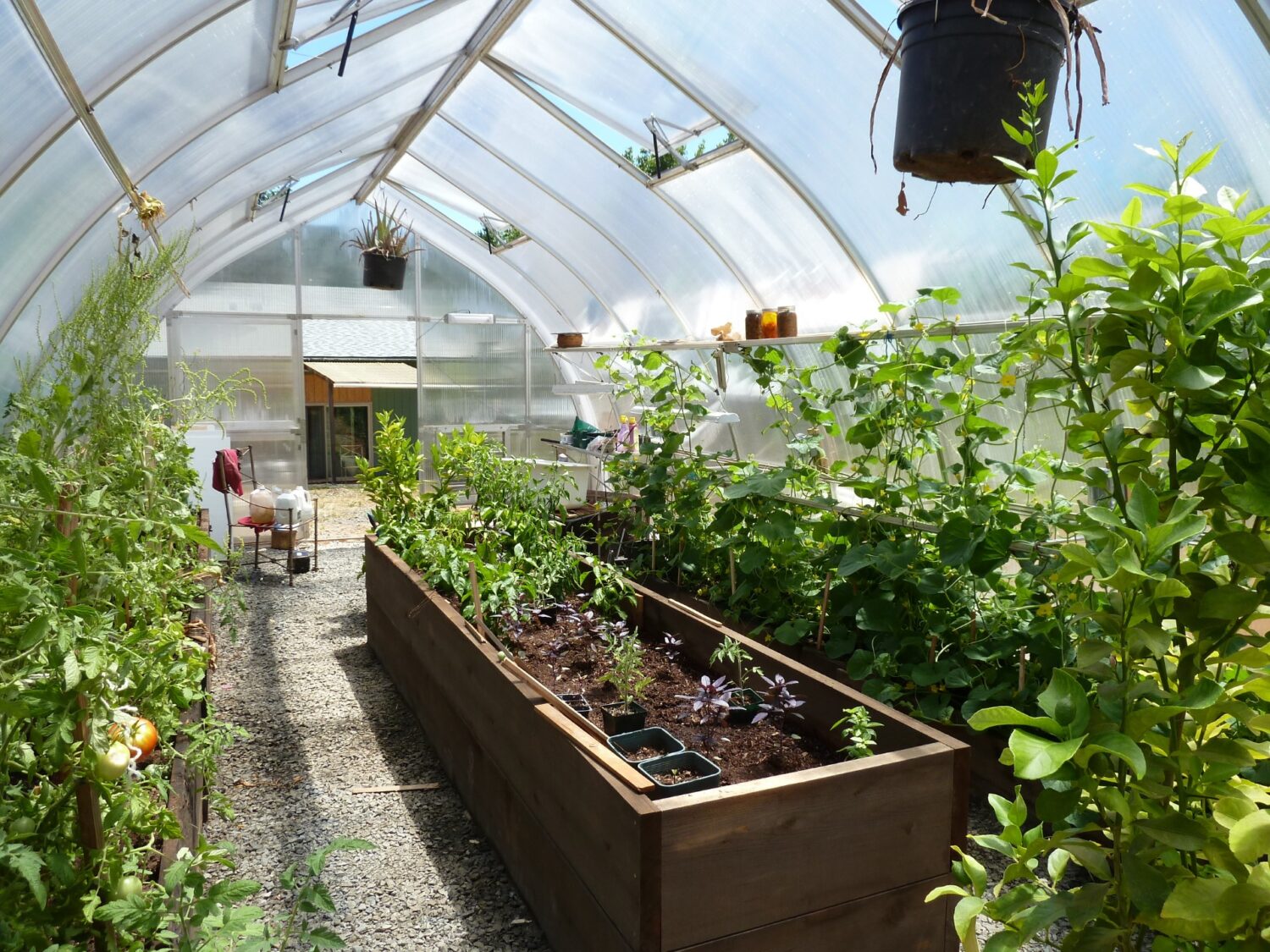
A Riga greenhouse is hard to mistake for anything else. With its sweeping curved walls and unmistakable onion-shaped roofline, the Riga greenhouse has become something of an icon among serious greenhouse gardeners. It looks a little like a greenhouse, a little like a conservatory, and maybe a little like something an eccentric European botanist would have built to protect his prized tomatoes from an incoming snowstorm.
That distinctive shape isn’t just there to make the neighbors ask where you got it, either. The Riga’s unusual profile is an important part of its engineering, helping the greenhouse contend with wind, shed snow and debris, and create a protected environment for serious growing. And the story behind those famous curves starts in Germany almost half a century ago.
It Started With a Greenhouse in a Family Garden
Before there was a Riga greenhouse, there was a rounded greenhouse in the Hollander family’s garden. In 1978, engineer Werner Hollander built the first “Thermo-Rundbogen-Gewächshaus,” or rounded greenhouse, for his own family in Germany.
Friends and acquaintances took notice. Interest in the design grew, more greenhouses followed, and in August 1982 Hollander founded Hoklartherm in Westerstede-Lindern, Germany. By 1984, the company had begun producing aluminum greenhouses. Today, Hoklartherm continues to develop and manufacture its greenhouse systems in Germany.
More than four decades later, curves are still a defining feature of one of the company’s most recognizable designs: the Riga greenhouse.
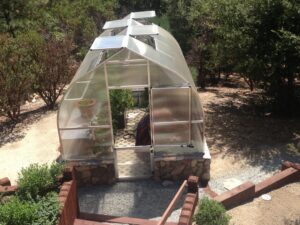
The Onion-Shaped Greenhouse That Refuses to Be a Box
Most backyard greenhouses follow a familiar formula: straight walls, a pitched roof and plenty of corners. The Riga takes a very different approach.
Hoklartherm calls it a Gothic shape and also describes the Riga as having a practical onion shape. Whatever you call it, you know one when you see one. The walls sweep upward into a curved roof rather than meeting it at the hard angle of a traditional A-frame greenhouse, creating the Riga’s instantly recognizable silhouette.
More importantly, those curves change the way the greenhouse interacts with the weather. This is one of those rare cases where a design feature manages to be both the thing that makes the greenhouse look interesting and the thing that helps make it perform.
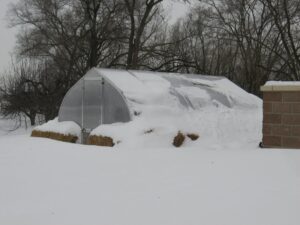
Snow Has a Harder Time Getting Comfortable
Put snow on a relatively flat surface and it has a tendency to stay there. The Riga’s steep, curved side walls encourage snow to slide down and away rather than accumulate as easily on the roof. Hoklartherm specifically points to optimal snow shedding as one of the advantages of the Riga’s shape and notes that the curved roof also helps prevent debris from collecting on top.
Of course, no greenhouse should simply be ignored during an extreme snow event. Proper installation, anchoring and snow management still matter. But the Riga begins with a shape designed to work in its favor when winter arrives. Think less “snow shelf” and more “snow slide.”
If winter weather is a major part of your greenhouse decision, our guide to the best greenhouses for snow and wind goes deeper into the structural features that matter when choosing a greenhouse for challenging climates.
And Then There’s the Wind
The same curved profile that helps the Riga deal with snow also helps it interact differently with wind. Instead of presenting the wind with the tall vertical wall and abrupt roof transition of a conventional greenhouse, the Riga gives it a smoother, curved profile. Hoklartherm describes the design as offering minimal wind resistance, making the unusual shape a functional part of the greenhouse rather than an architectural flourish added afterward.
But the shape is only part of the equation. Underneath the polycarbonate is a substantial aluminum structure. The standard Riga sold by Exaco uses 13-gauge aluminum framing, and the design incorporates long, continuous structural components.
For example, the Riga’s roof beam can run the length of the greenhouse, up to 20 feet in a single piece, while the curved side framing is also manufactured as one piece. Those long components might make the shipping box a little more interesting, but they also reduce the number of connections in major structural areas and, therefore, the number of potential weak points.
It’s the kind of detail you might never notice while comparing pretty greenhouse photos online. When the weather gets ugly, it suddenly becomes much more interesting.
You can see how these construction details stack up against more typical greenhouse kits in our Riga vs. the Competition comparison. If wind is your biggest concern, our guide to choosing a high-wind greenhouse takes a closer look at what matters beyond the claims printed on the box.
Polycarbonate Is a Big Part of the Riga Formula
The frame and shape are only part of what makes a Riga a Riga. The glazing matters just as much.
The standard Riga greenhouse uses 8 mm twin-wall polycarbonate on the side walls and 10 mm twin-wall polycarbonate on the gable ends. That distinction matters because not all “polycarbonate greenhouses” are built with the same polycarbonate.
Panel thickness, construction and quality can have a major impact on insulation, durability and the growing environment inside a greenhouse. Twin-wall polycarbonate contains insulating air space between its layers while also diffusing incoming sunlight, giving growers a combination of light transmission, durability and insulation that makes it particularly well suited to serious greenhouse growing.
For gardeners interested in extending the growing season or continuing to grow through colder weather, those insulating properties become increasingly important. It’s also one of the biggest differences between the Riga and many lighter polycarbonate greenhouse kits, something we explore further in Riga Polycarbonate Greenhouse vs. Other Options: What Actually Matters.
And if you want to take insulation even further, the larger Riga XL steps up to substantial 16 mm triple-wall polycarbonate glazing. That moves things a little further away from “I’d like somewhere to start tomatoes in April” and closer to “I have plans for February.”
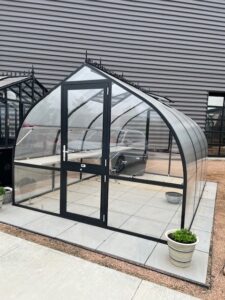
Then the Riga Put on a Black Suit
For years, there was an aesthetic tradeoff some greenhouse shoppers struggled with. They loved the durability and insulating benefits of polycarbonate, but they also loved the crystal-clear appearance associated with traditional glass greenhouses.
Enter the Riga Black.
The Riga Black takes the familiar curved Riga profile and gives it an entirely different personality. The heavy-duty aluminum frame is powder-coated black, immediately giving the greenhouse a more architectural appearance. But the biggest visual change happens at the front.
Instead of using twin-wall polycarbonate across the entire structure, the Riga Black uses 6 mm crystal-clear single-layer polycarbonate on the front gable and door. That clearer front opens up the view into the greenhouse and creates more of the transparent appearance people often associate with glass, while retaining the durability and break resistance of polycarbonate.
Along the sides, the Riga Black retains 8 mm twin-wall polycarbonate, while the rear gable uses 10 mm twin-wall polycarbonate. Rather than abandoning the insulating characteristics that make the Riga so useful, the design concentrates that crystal-clear look where it makes the biggest visual impact: right up front.
There’s one more detail that changes its personality. The Riga Black adds Victorian-style cast metal roof cresting and decorative finials, giving those German-engineered curves a little old-world flourish.
The result is surprisingly different from the classic aluminum Riga. It has the same unmistakable silhouette and the same German greenhouse heritage, but the black frame, clearer front and decorative detailing give it a decidedly more dressed-up appearance. The Riga, you might say, put on a black suit.
The Riga Is Unusual for a Reason
Greenhouses are often compared almost entirely by dimensions: 8 x 10, 10 x 14, 10 x 20. But footprint alone tells you surprisingly little about how two greenhouses are actually built or how they may perform once they’re standing in your garden.
The Riga is a good example. Look beyond the dimensions and you start finding the decisions that define it: curved walls designed to help shed snow and debris, a profile designed with wind resistance in mind, thick twin-wall polycarbonate glazing, heavy-duty aluminum framing and long structural components that reduce connection points.
Then there are the practical growing features. The Riga includes automatic roof ventilation, a split barn-style locking door and a rear window for additional airflow. These aren’t simply decorative structures designed to look impressive at the end of a garden. They’re greenhouses intended to be used.
Suddenly, that onion shape doesn’t seem so quirky. It seems pretty clever.
A Greenhouse Design With Roots Going Back to 1978
There is something fitting about Hoklartherm’s story beginning with a rounded greenhouse built in a German family garden in 1978. More than four decades later, one of the company’s most recognizable greenhouses is still defined by its curves.
The Riga greenhouse doesn’t look like every other greenhouse because it wasn’t designed like every other greenhouse. Its Gothic onion shape gives it an unmistakable architectural presence in the garden, while its curved walls help it contend with wind, snow and debris. Its thick polycarbonate glazing creates an insulated growing environment, and its German-engineered aluminum structure is designed for gardeners who expect their greenhouse to be around for more than a season or two.
Sometimes iconic design starts with aesthetics. With the Riga, the engineering helped create the icon. The fact that it looks this good is a pretty nice bonus.
Is a Riga Greenhouse Right for You?
If you’re looking for a greenhouse designed for more than fair-weather gardening, the Riga family is worth a closer look. Explore the Riga greenhouse for the classic German-engineered design, step up to the Riga XL for more space and 16 mm triple-wall glazing, or take a look at the Riga Black for a striking black frame and crystal-clear polycarbonate front.
And before you choose, see how the details stack up in our Riga vs. the Competition comparison. Because when you’re investing in a greenhouse, the difference isn’t always obvious from the outside. Sometimes, it’s hiding in the curve.